The right wing cultural hysteria over the decision by Dr. Seuss Enterprises, a private company tasked with preserving Dr. Seuss’s legacy, to cease publication of six books, is as ridiculous as it is disturbing. Dr. Seuss was not canceled.1 His books are not being burned, they are not being pulled from shelves, and they are not banned from libraries or schools. Instead, Dr. Seuss Enterprises, decided to cease publication of six titles, because they contain racist images.
“Then why not make them a teachable moment?”
Really? The target audience for these books are kids three to seven years old. Kids that age aren’t really capable of the nuanced and difficult conversations that older kids and adults can have about such difficult subjects, like, for example, the use of the “n” word in Huck Finn.2 I mean, let’s be honest, far too many adults aren’t capable of those nuanced discussions, either. Not to mention, that at 7 p.m., when they’re tucking their wee ones into bed, the last thing the parents of a three or four year old wants to do, is start an explanation about racism. They’re reading to their kid, after a long day, and simply hoping that their kid will just go the fuck to sleep so they can go drink that glass bottle of wine in peace.
It’s also unlikely the kid is going to comprehend a discussion about the historical context of systemic racism and the use of imagery to perpetuate it. Hell, I remember getting blank looks when I tried to convince my young boys to just please get the pee in the toilet, thanks. Yet, studies show “that children as young as three can form racial biases, and those biases become fixed by age seven,” the exact target age of the books.3 Thus, Dr. Seuss Enterprises, after listening to a variety of experts, including teachers and academics, made the decision to cease publication of the six books, noting that they want Dr. Seuss’s books to reflect and support a variety of families and communities.
People, that is not cancelation, it’s curation. If you’re feeling a bit cynical about it, you could even say that it’s one of the most free-market, capitalist things a company can do: cater to the shifting norms and understanding of the society that constitutes its consumers. You don’t see any companies producing and trying to sell VHS tapes anymore, do you? You don’t see Lysol marketing itself as a contraceptive anymore, do you? Yes, that was really a thing that happened, and while kudos to them, I guess, for trying to sell a product that would otherwise be illegal for women to obtain at the time, it not only didn’t work, but was horrifically dangerous, and lethal.4
Curation of a company’s product line is not a new concept in publishing either. Fans of the classic film Willie Wonka & The Chocolate Factory, may recall that their beloved Oompa Loompas were orange creatures from a fictional land. Not so in the original publication of the book, wherein they were pygmies from Africa, brought by Wonka as slaves. On a ship. In cases with air holes in them (making Veruca’s demand that her father buy her one, even worse). The NAACP criticized this depiction, and Roald Dahl himself changed the book. The publisher of The Hardy Boys and Nancy Drew, have revised both those series, as early versions were replete with “dark,” “swarthy,” or “hook nosed” villains, among other problematic tropes.5 P.L. Travers, in a display of the aforementioned free-market, capitalist concept, revised Mary Poppins, after people objected to a racist description of a Black woman, stating that she did so not in apology, but because she didn’t, “wish to see Mary Poppins tucked away in a closet.”6 Even Dr. Seuss himself attempted some imperfect, if well intentioned, revisions of a few of his works, to tone down the racist stereotypes.7
“But it’s erasing our culture!”
Which culture is that, exactly? Is it the predominantly White culture that has ruled America since her inception, where racist images and tropes have cultivated and sustained the predominance of said White culture, despite our claims that we’re a “melting pot”, and pride in our immigrant heritage? No? Then do tell, because honestly, if your knee jerk reaction to no longer publishing a children’s book with racist images in it—images most people would object to in a brand new book—is to claim that your culture is being canceled, one has to wonder about the nature of your culture. In fact, me thinks I hear the Daughters of the Confederacy calling.
Seriously though, why is it that every time something people may not have originally realized was racist or otherwise insensitive is held up to criticism, the reflexive reaction is to act like something priceless is being taken away from them personally? Do they fear that their previous enjoyment of it will brand them as a racist? News flash: until you freaked out about racist images being “taken away from you,” no one thought you were a racist. So, hey, congratulations on outing yourself, I guess?
As a couple who grew into adolescence in the ’80’s, and enjoy sharing some of our beloved 80’s movies with our kids, my husband and I often are confronted with, “oh shit, I forgot about this part,” moments. Our memories supply us with how much we loved a given movie, but not about a given racist, or homophobic comment, or you know, rapey scene that everyone thought was funny at the time. That doesn’t mean we think that we’re racists, homophobes, or people who condone rape, or that others think we are. Rather, we think about the way some of those awful ideas were casually insinuated into the fabric of our society at the time, and how they redounded down into the perpetuation of racism, homophobia, and rape culture, and the work that has been done, and continues to be done, to counter those things.
Thankfully, unlike the target audience of Dr. Seuss’s books, our kids are of an age to have discussions about these difficult topics, although these days, they’re also discerning and educated enough, that they’re the ones most likely to point out the problem first. Guess what though? We don’t feel like our youth is being erased, just because some of the movies of that time are, in fact, actually horrible when viewed through a more educated and evolved lens, and should probably be consigned to the dumpster of history, or at least shown with context—you know, a teachable moment.
“Ok, you told us why it’s terrible, but why is it also ridiculous?”
Ah, this is where irony, reading, history, and biography come out to play, and point to the utter absurdity of right wing, conservative, Republican hysteria over Dr. Seuss. Most people are unaware that Dr. Seuss was also a political cartoonist for PM magazine, in the early 1940’s.8 During that time, Dr. Seuss penned scathing cartoons surrounding the isolationist, anti-intervention group, the America First Committee—which sought to keep America uninvolved in any way in WWII—because the AFC was highly entangled with the anti-Semitic, Nazi sympathizer Charles Lindbergh.9 While the AFC’s members included people from a variety of walks of life and political parties (including future presidents Ford and Kennedy), the membership of Lindbergh, and others of similar beliefs, nevertheless painted an ugly picture of American isolationist ideology. In addition to his cartoons opposing the AFC’s anti-intervention policies, and despite some of his earlier problematic imagery, Dr. Seuss also penned cartoons opposing anti-Semitism and racism.10 That the phrase, “America First,” was a rallying cry for Trump and so many of his supporters, was definitely not lost upon several historians and writers in 2016.
(Below is a sampling of Dr. Seuss’s work for PM.)
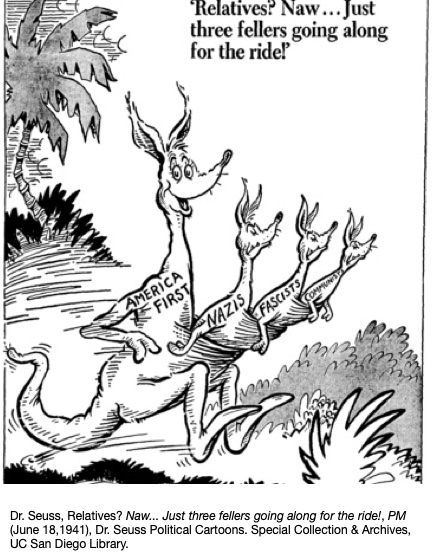
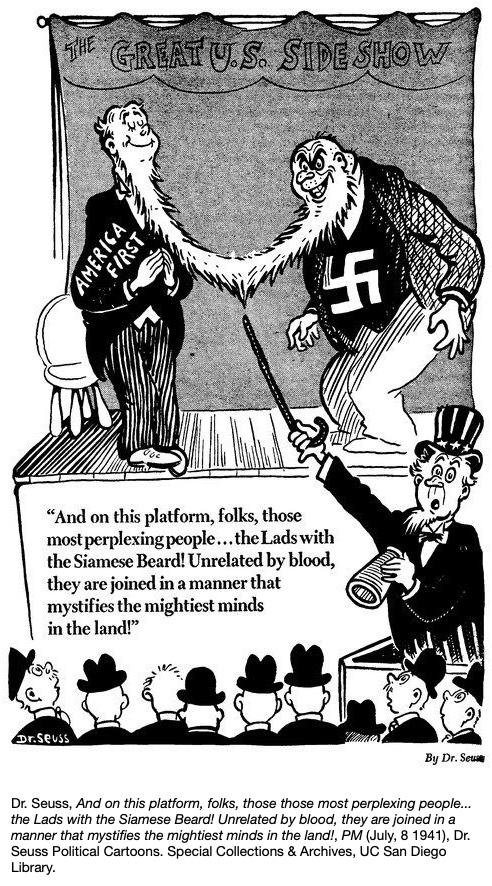
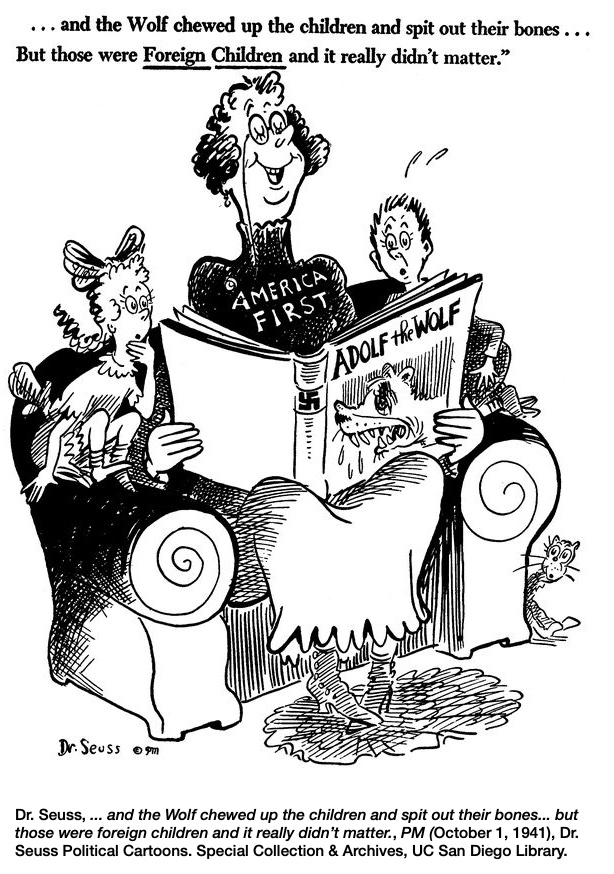
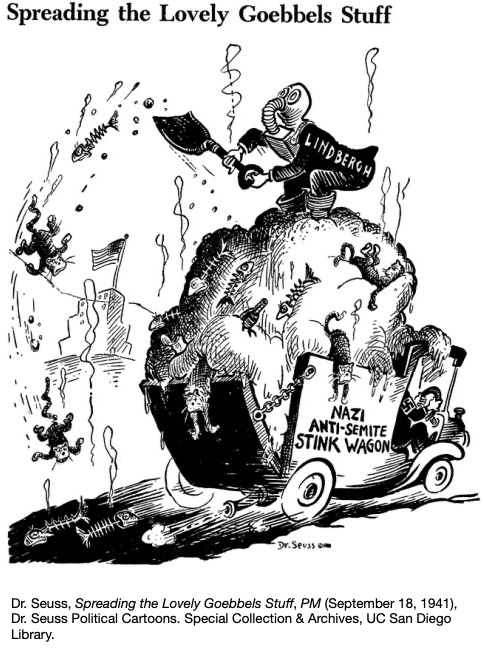

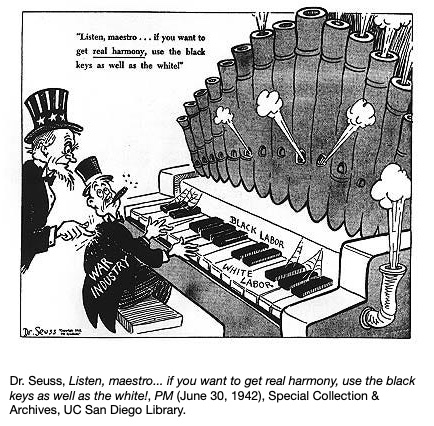
So, I find it beyond hilarious that the MAGA crowd, which so willingly embraced Trump’s “America First” rhetoric and policies, which consistently clutches its pearls over comparisons to Nazis and fascists, while wearing anti-Semitic shirts to storm the U.S. Capitol, whose responses to asylum seeking children in cages ranged from “it’s their parents’ fault,” to someone else “did it first,” and who helped drive an increase in hate crimes against Jews and other minorities over the last several years,11 is suddenly in a lather about an author who would likely have eviscerated them in his political cartoons.
But wait, it gets better! If these folks had ever actually read, but more importantly understood Dr. Seuss’s books, they’d know that, problematic illustrations aside, the messages are incredibly progressive, and in direct opposition to conservatism and Republican policies. In fact, they’re downright subversive! And when you think about how those messages are reaching young, impressionable minds, well, how dare Dr. Seuss indoctrinate our children in the concepts of tolerance, diversity, environmentalism, and the undermining of authority?!
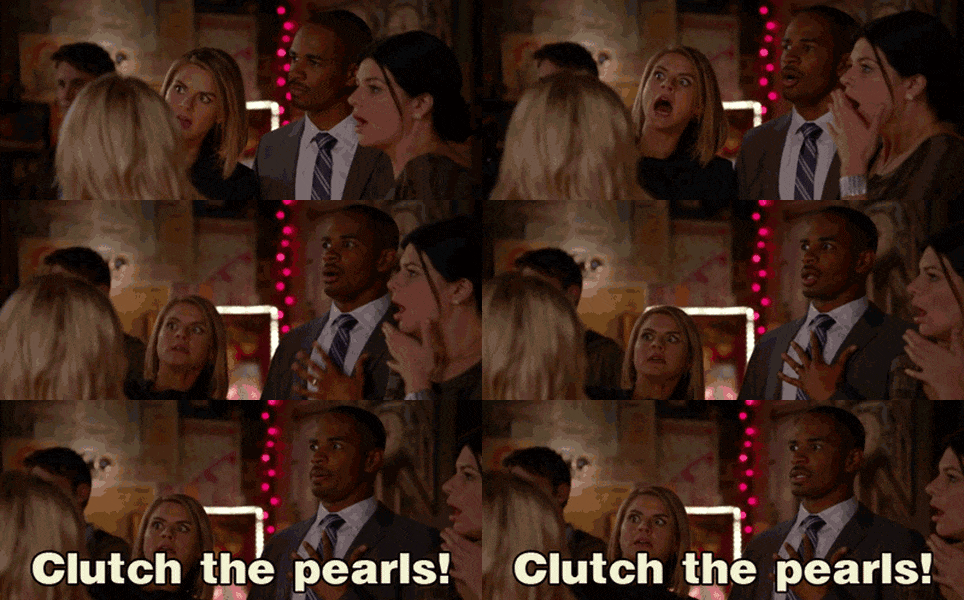
Yes, I live for sarcasm, but it is all true. The Cat In The Hat, is about bucking authority and not conforming to expectations. The Sneetches and Other Stories, is a cautionary tale about racial prejudice and anti-Semitism, just as The Grinch Who Stole Christmas, is one about consumerism and the commodification of Christmas. The Lorax, is a poignant tale about environmentalism, and the dangers of industry and greed, while The Butter Battle Book, tackled the arms race. I Can Read With My Eyes Shut, stresses the importance of education, while Green Eggs and Ham, encourages people to step outside their comfort zones and experience new things.
If we’ve learned anything from the Trump years, and the ascendancy of this new Republican Party and its purported conservatism, it is that they gravitate to the conformity of authoritarianism, cling to White nationalism and racism, advocate for consumerism to the point of encouraging grandparents to take one for the team during a pandemic and die for the economy, gleefully deregulate environmental protections for the benefit of corporate profits, continue at times to escalate tensions with potential nuclear adversaries, attack education as “elitist,” and shun the concept of multiculturalism, in a fear riddled refusal to step outside their comfort zone of American superiority. The GOP and right wingers who are screaming the loudest over Dr. Seuss Enterprises choosing to stop publishing books with racist imagery, are the literal antithesis of every message Dr. Seuss’s books try to instill in our children.
And that? That is pure, glorious, ridiculous absurdity.
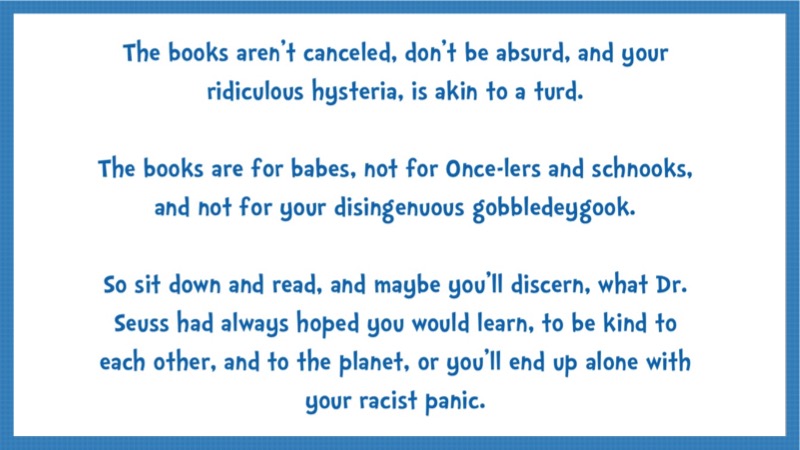
- I was going to address the idea of “cancel culture,” but honestly that could be an entire post of its own. Simply put, however, the term is really a way to delegitimize the criticism of racist, sexist, homophobic, and other comments, jokes, and behavior, by those who have heretofore enjoyed the privilege of saying nearly anything they want, without consequence. While I believe reasonable conversations can be had around these topics, this catch-all phrase is used a casual dismissal of all such criticism, much like complaints in previous decades that “political correctness” had run amok, when people were told that using “faggot” and “retard,” were no longer socially acceptable. ↩︎
- A simple online search of Huck Finn, and “racist language” turns up articles and classroom syllabuses dedicated to analyzing the usage of the word in the book, as well as greater discussions about the power of language. ↩︎
- https://www.theguardian.com/books/2021/mar/02/six-dr-seuss-books-cease-publication-racism; https://www.theguardian.com/books/2021/mar/02/six-dr-seuss-books-cease-publication-racism ↩︎
- https://www.smithsonianmag.com/smart-news/lysols-vintage-ads-subtly-pushed-women-to-use-its-disinfectant-as-birth-control-218734/; https://www.smithsonianmag.com/smart-news/lysols-vintage-ads-subtly-pushed-women-to-use-its-disinfectant-as-birth-control-218734/ ↩︎
- In some ways this too was problematic, as they replaced ethnic villains with White ones, making the books generally very White, but the point is that they acknowledged the problem, and the books have never been out of print. https://www.theguardian.com/books/2021/mar/09/dr-seuss-cancelled-theres-nothing-new-about-cutting-racism-from-childrens-books ↩︎
- https://www.nytimes.com/1996/04/25/arts/p-l-travers-creator-of-the-magical-and-beloved-nanny-mary-poppins-is-dead-at-96.html ↩︎
- https://www.theguardian.com/books/2021/mar/07/dr-seuss-books-product-recall-cancel-culture ↩︎
- Actually, most people aren’t aware that even earlier in his career, he drew some awful racist advertisements, although his later works illustrate his evolution, however flawed, on that matter. https://www.businessinsider.com/before-dr-seuss-was-famous-he-drew-these-sad-racist-ads-2012-3#-10 ↩︎
- https://www.britannica.com/topic/America-First-Committee; https://www.britannica.com/biography/Charles-Lindbergh/Germany-and-the-America-First-movement ↩︎
- Despite his evolving position on racism against Blacks, and his opposition to anti-Semitism, Dr. Seuss was, like many others at the time, virulently anti-Japanese, and eventually supported the internment of Japanese-American citizens—something he later came to regret. His depictions of the Japanese people, and Japanese-American citizens, at that time were horribly racist. In 1953, however, he visited Japan, and a year later wrote Horton Hears A Who, which contained the line, “A person is a person no matter how small,” and was dedicated to “My Great Friend, Mitsugi Nakamura of Kyoto, Japan.” It is regarded by many as not just an apology for his previous, but an allegory about the American occupation of Japan. https://www.openculture.com/2014/08/dr-seuss-draws-racist-anti-japanese-cartoons-during-ww-ii.html; https://www.artsy.net/article/artsy-editorial-dr-seuss-satirized-america-first-decades-donald-trump-made-policy ↩︎
 Musings of a Restless Mind