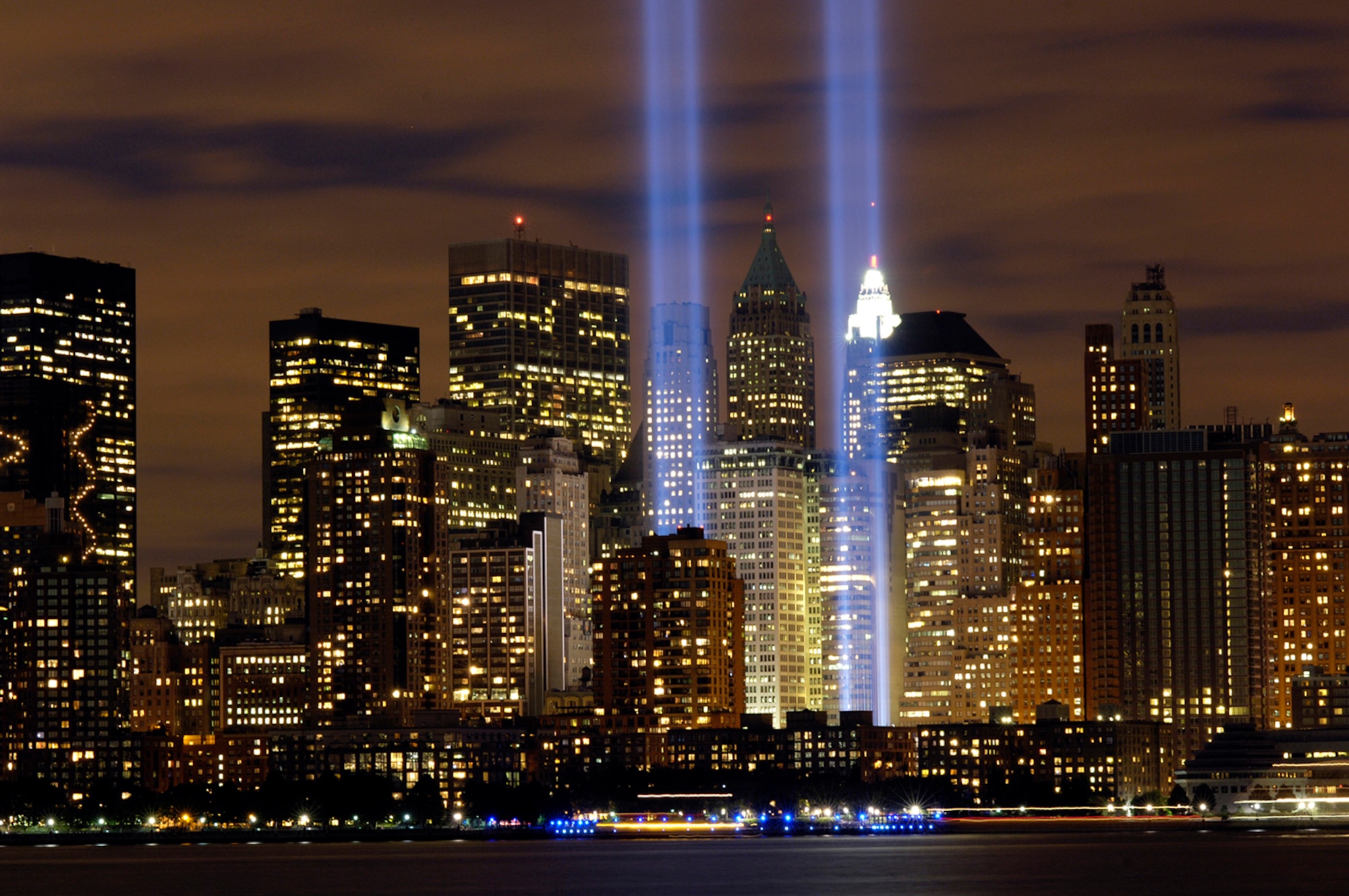
As Angelenos, and despite having friends and family on the East Coast, it’s not statistically surprising that we didn’t personally know anyone who died on 9/11. Obviously, my New York City friends were personally impacted by 9/11 in a variety of traumatic ways, but until a few years ago when I learned that the sister of one of my husband’s business associates lost her life in the south tower, I hadn’t known anyone who lost a loved one, a family member, on that day. When my husband and I visited the 9/11 Memorial and Museum in October of last year, seeing her name in the memorial exhibit, was a visceral reminder of how interconnected we all are.
Despite being on the opposite side of the country, the events of 9/11 were, as it was for so many, traumatizing for our family. I remember that my mother-in-law called and told us to turn on the news because a plane had crashed into the World Trade Center, and as soon as we did, we saw a plane hit a tower. We thought they were replaying the crash, until a moment later our brains caught up with our eyes, and we realized that one tower was already on fire, and we had just witnessed the second plane hit the south tower. It became immediately apparent that this wasn’t an accident, but an attack, and we watched, horrified, as people desperately waved from the top floors, praying for rescue. We watched as some fell to their deaths, and then finally, as the towers themselves came down, shocked by the devastation, and the knowledge that so many were still inside. Over the course of the day, we also learned of the attack at the Pentagon, and eventually of the heroism of the passengers of Flight 93.
To this day I cannot bear to watch movies about 9/11. I’m crying as I write this, and I know that I’m not alone in those feelings. 9/11 reshaped America.1 It was a wake up call to some younger Americans, perhaps like Pearl Harbor was for our grandparents’ and great-grandparents’ generations—an object lesson that we are not untouchable, and that the tentacles of hate and war can reach anyone, anywhere, anytime. The relative bubble of safety that the post-Cold War school-aged GenX and Millennials grew up in was shattered on 9/11.2 While for those of those of us raised during the Cold War and specter of nuclear holocaust—Boomers who spent their childhoods absurdly diving under desks during nuclear strike drills, and GenXers who fatalistically figured we were just gonna die anyway—the relief we felt at the fall of the Soviet Union, of believing that at least our kids and grand-kids wouldn’t grow up with those same fears, was replaced instead with a color coded Homeland Security Advisory System induced anxiety, and two decades of actual, boots on the ground war. My oldest child was 21 months old on 9/11, and my two youngest, now 17 and 19 years old, weren’t even born. The entirety of my children’s formative years was spent in a nation at war,3 removing their shoes, belts, and electronics in airports, and worrying for the first time since the 60’s, whether the nation would resume the draft by the time they turned 18. I’ll also point out the irony that, like their grandparents before them, our nation’s children are once again learning to dive under desks, and stay safe, because our nation has gone so mad, that the horrific events of Columbine are now seen as so commonplace, that a vice presidential candidate lamented that “they are a fact of life.”4
What is so very disheartening, and in some ways is one of the goals Al-Queda succeeded in achieving on 9/11, is the tearing apart of our country. Of course, in the initial aftermath, there was enormous unity of purpose, national pride, and even of politics. Looking back to 2001, the vote on the Authorization for the Use of Military Force, which granted the executive branch nearly unlimited authority to wage war in Afghanistan or against anyone harboring terrorists, was only one vote short of unanimous in the House.5 Representative Barbara Lee’s nay vote, which saw her excoriated by the public and colleagues alike, in retrospect, is now seen by many as the right vote—not because we shouldn’t have responded at all—but because the bill was passed in reflexive, knee jerk anger and pain, and not implemented with any thought to restraint. There is a chasm of distance between righteous response and evil. Whatever you think of Nietzsche, he was right when he said, “He who fights with monsters might take care lest he thereby become a monster. And if you gaze for long into an abyss, the abyss gazes also into you.” Yet, as a nation, as a sleeping giant roused by great pain, we were rightly one in purpose, but perhaps we gazed into the abyss a little too long.
As the war in Afghanistan slogged on, the fear of further terrorism out of the Middle East was cynically leveraged as a pretext to invade yet another country—a decision which was not only wrong on factual grounds,5 and made with seemingly little geopolitical acuity,6 but which eventually led to the devastating financial repercussions of financing two wars abroad, and helped propel us into the polarized and partisan nation we see today. War fatigue and a failing economy led us to elect our first Black president, but it also birthed a regressive, racially driven movement within the Republican Party, culminating in the election of a man who is, not only a felon and aspiring dictator, but a petty narcissist unfit for office in myriad ways, who seeks to curry the favor of, and hand over our democracy to, this nation’s anti-democratic enemies.7
If Osama bin-Laden were still alive today, I fear he would be laughing at how, in a mere 23 years, the span of only one generation, we’ve gone from something like a family that has heated—often undeniably ugly—disputes, but which was slowly (oh so slowly) making forward progress, to one that is sadly divided along racial, ethnic, gender, and religious lines, where the guardrails of democracy have been systematically attacked, and which, as we approach this next election, teeters on the brink of dictatorship and fascism. I believe that 9/11, and our response to it, handed our enemies abroad a nation primed for the infiltration of propaganda and dissemination of misinformation, that helped lead us to this point.8 Of course other things played their part, I haven’t accounted for every event or variable, but when I look back at the last 23 years, this is what I see.9
I believe that the ugliest among us—those on both ends of the political spectrum who spew invective, revel in racism, misogyny, homophobia, antisemitism, authoritarianism, and nationalism—are not the majority of our 328 million citizens and residents. I also believe that we can heal our nation, but to heal, we must be willing to expunge and/or de-radicalize the worst elements of our major political parties, and sometimes, our families. We must clamp down hard on the intentional misinformation and propaganda that festers online, that has infiltrated our institutions of learning,10 and we must clean house in our once vaunted Fourth Estate. Yes, democracy dies in darkness, but it also dies if the only light shining on it is the garish neon glow of infotainment.
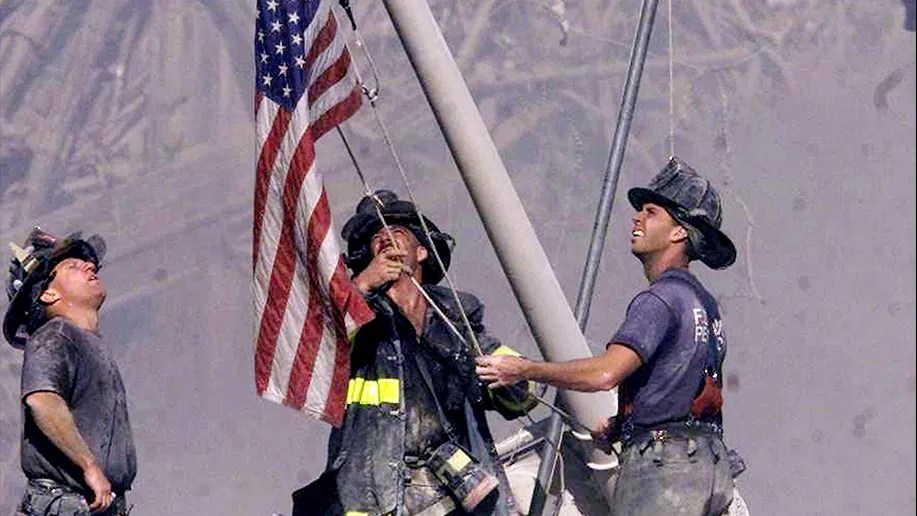
I didn’t intend this to be a political post when I started writing. It began as a way to express my pain and sorrow over the horrific events on 9/11, to remember the 2,996 lives lost that day, and to honor the heroes—first responders and volunteers alike—who bravely rushed in to save others. On that day we saw so many fellow Americans who dug through the rubble together, cried together, stood together and proudly raised our flag together. After 9/11, we saw our young men and women volunteer to serve in two wars not of their making because they believed in the aspirational (if not always successful) promises of our democracy. Remembering all those things simultaneously fills me with pride and humbles me, and yesterday, as I watched news stations report on the various memorial services, or recount stories from that day, I realized that part of my continued pain and sorrow from that awful day is because so many of the same people who stood shoulder to shoulder, are now divided by hate and polarizing rhetoric, and I admit to falling prey to that as well.
I’m not minimizing the need for bright line positions. For example, I don’t believe we should entertain, and thereby legitimize as serious, positions that deny people’s basic humanity and human rights, nor can we ignore the impossibility of coming to the table with those that don’t even believe we have a right to sit at it. The both sides insanity which perpetuates this, and which we have nurtured in this country, must end. However, I must believe that those bright lines need only apply to the extremes in the parties, and not the entirety of our polity, or this great democratic experiment has already failed, Al-Queda won, and all of this is merely our death throes.12
So if you truly wish to honor the memories of those lost on 9/11, and the heroes, be they first responders or soldiers, who died that day and in the years since, take a moment to reflect and remember what makes this country something worth their sacrifice.12 Think about how we restore those values of unity and patriotism, of celebrating the unique nature of our “melting pot,” and of helping our neighbors regardless of what they look like, who they love, how they worship, or who they voted for, without moving backwards and destroying values like personal dignity, empathy, learning, forward progress, and civil rights. And, even if we disagree—vehemently disagree—on the policies needed for this country to not just survive, but thrive, stop and think hard about whether getting that one thing that’s important to you, is worth throwing fellow citizens and residents under the bus. Stop and think if you’re really listening, or if you’re just hearing what you want to hear because you’re hurting.
None of what I wrote will matter to the extremes. Trump’s base is not going to desert him, and the Republican politicians who’ve made their obeisance to him won’t either. Likewise the implacable, uni-cause far-leftists aren’t going to vote for Democrats, or will continue to vote for the (now fewer!), far-leftists and problematic “progressives” in office. I’m not talking to any of them, and they sure as shit are not listening to me. No, I’m talking to the fence sitters, to the people who generally find politics distasteful, and so they don’t always, or ever, vote. I’m talking to the people who live in suppressed communities, who are so very justifiably tired of feeling unheard, and who think they may not have the energy to stand in line all day again. I’m talking to those who by dint of economics, race, religion, gender, or whatever, are lucky enough to usually remain unaffected by upheaval in this country, and to weather all the social and fiscal vagaries that comes with it. I’m talking to people who think that they’re taking a stand by not voting at all, but are instead taking this hard won right of political franchise—one that millions around the world do not have—for granted. We are among the luckiest people in the world to live in a country where every citizen—regardless of race, gender, or creed—has the right to vote.13 In fact, I believe that exercising our franchise is more than just our right, it is our duty as citizens. Democracy requires three things to succeed: a system of checks and balances, an honest and informative press, and the robust participation of the citizenry.
Robust democracy requires robust participation. If you don’t love the choices? Who said you’re always entitled to? Who sold you the idea of perfection in politics? More importantly, who told you that leaving the room will get you heard in it later?15 And, who told you compromise was a dirty word? In a democracy, especially in ours, politics doesn’t merely involve compromises, it requires them, because 328 million people, will nearly never, ever agree 100% on everything. That’s reality, whether you like it or not.
So pull up your big kid pants, and vote for the greater good.
Vote for the safety and security of this country.
Vote like the people who risked their lives on that terrifying day 23 years ago to save as many as they could.
Vote like the volunteers who spent hours, days even, digging through the rubble hoping for a sign of life.
Vote like the beautiful people of NYC who ran to help the wounded, give shell shocked bystanders water, a phone to reassure their families that they were still alive, or just a sympathetic hug.
Vote like the people we’ve seen in the years since who get on boats during floods, go door to door after an earthquake, or during a fire, to rescue and evacuate neighbors and strangers alike.
And please do not vote like the people who tell you to fear or hate those neighbors and strangers, and who demonize them, or listen to people who tell you not vote, or give up because it’s hard. If your vote isn’t important, they wouldn’t be trying so hard to get you to stay home.
So, as I reflect on the 23 years since 9/11, and as we approach one of the most critical elections of our lifetimes, an election taking place during a period of upheaval and strife across the globe, it is the good and heroic people of that day, the memories of the victims, our national willingness to set aside differences—both petty and large—and the knowledge that we are one nation and always stronger together, that I am left with.
So that’s why and what I will be voting for. Not just for my kids or my family, or the security of our democracy, but also for the millions of others who call this country home, because all of their lives depend on our choices too, and that is part of the duty and burden of citizenship.
- In fact, I don’t think it’s hyperbole to say 9/11 reshaped the world. ↩︎
- The Berlin Wall fell in 1989, when the youngest GenX’ers and oldest Millennials were only 9 years old. ↩︎
- Obviously, while we were not waging war on American soil, we were a nation that spent 20 years on a war footing, with all that entails. ↩︎
- Whatever else I feel about Senator Vance, I know he was not merely shrugging away the issue—on this one comment, I actually think he was right, because here we are in September 2024, and there have already been 46 school shooting, and until we figure out how to stop them, they are actually a horrifying fact of life in this country. They absolutely shouldn’t be, but they are. ↩︎
- In the Senate, the vote was 98 ayes, 0 nays, and 2 present/not voting. ↩︎
- The Bush Administration’s weaponization of American fears, made it easy to convince many of the false allegation that Iraq was building vast weapons of mass destruction. This not only sent us to war under false pretenses, but burned some of the trust of our allies, and for Americans, diminished trust in our president, as well as our intelligence and foreign services. ↩︎
- The toppling of Saddam Hussein, and failure to fully stabilize, fund, and bolster Iraq as a counterweight to the Islamic Republic of Iran (IRI), created a power vacuum readily filled by both ISIS and the IRI, and propelled the IRI into one of the strongest powers in the region, and ironically, the biggest funder and supporter of terrorism in the world. ↩︎
- Polling in the 2008 election indicated that the economy was the top issue for voters. https://news.gallup.com/poll/109759/Gallups-Quick-Read-Election.aspx The Tea Party Movement began in 2009, the first year of Obama’s presidency, and that is when we truly begin to see the fractures that led to where we are now. ↩︎
- The conspiracy theories, denialism, and scapegoating—even in the face of Al-Queda’s boasts—took very little time to spread. ↩︎
- When the wars in Afghanistan and Iraq began, Facebook and Twitter did not exist. The exponential rate at which propaganda, misinformation, and disinformation sown by enemies foreign and domestic, could not have been predicted. ↩︎
- In our primary and secondary schools, extremists are banning books and waging wars against librarians, teachers, and LGBTQ+ students, while at our institutions of higher learning, decades of foreign funding was designed to influence students and shape policy via historical revisionism and the cynical use of the United State’s own social and racial reckonings. ↩︎
- On my most cynical and hopeless days, when I think of how many people voted for Trump not once, but twice, and still plan to, I fear this may be true, and then I think about how many did not. I think about how many Republicans have left the party, or have refused to support him because they love our country more than any policy dispute, or even perhaps their biases. ↩︎
- More firefighters have now died from 9/11 related illnesses than died that day, and over 7,054 U.S. military members died in both Afghanistan and Iraq. https://abc7ny.com/post/september-11-more-members-fdny-have-died-911-related-illness-were-killed-day-attack/15282126/ https://www.statista.com/statistics/303472/us-military-fatalities-in-iraq-and-afghanistan/ ↩︎
- That many don’t have access to vote is, for anyone who is paying attention, just one reason this election is so incredibly important. ↩︎
- If you don’t vote, you aren’t heard. Period, end of discussion. Maybe, if you’re lucky, at some point someone will need you and court your vote. Or, maybe not, and you spend a lifetime angrily in your feels, and tilting at windmills. ↩︎
 Musings of a Restless Mind