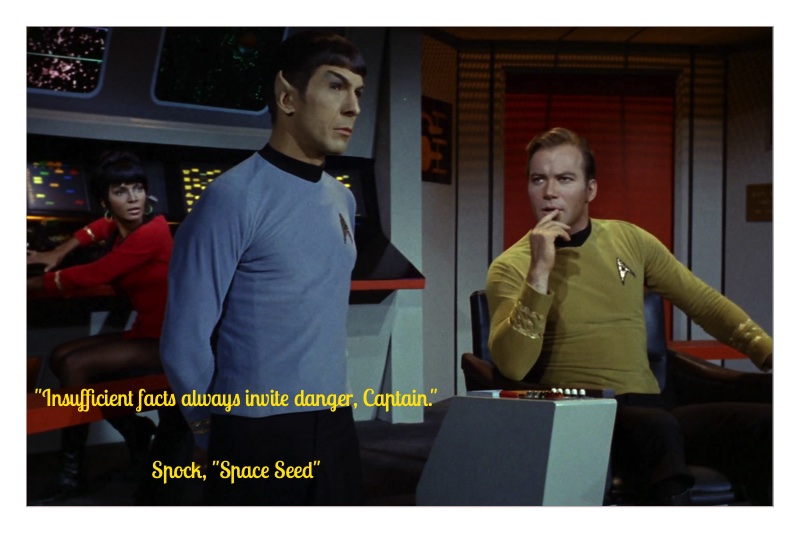
Who controls the past, controls the future: who controls the present, controls the past… The mutability of the past is the central tenet of Ingsoc. Past events, it is argued, have no objective existence, but survive only in written records and in human memories.
George Orwell, 1984
Orwell’s novel states a premise that certain people in our media and politics seem to have a very firm grasp of, and they are working as hard as Oceania’s “Ministry of Truth,” to ensure that events of the past “have no objective existence,” so they can be manipulated and weaponized in our current culture wars.
To wit, as I was scrolling through Twitter a couple of days ago, I came across this gem:
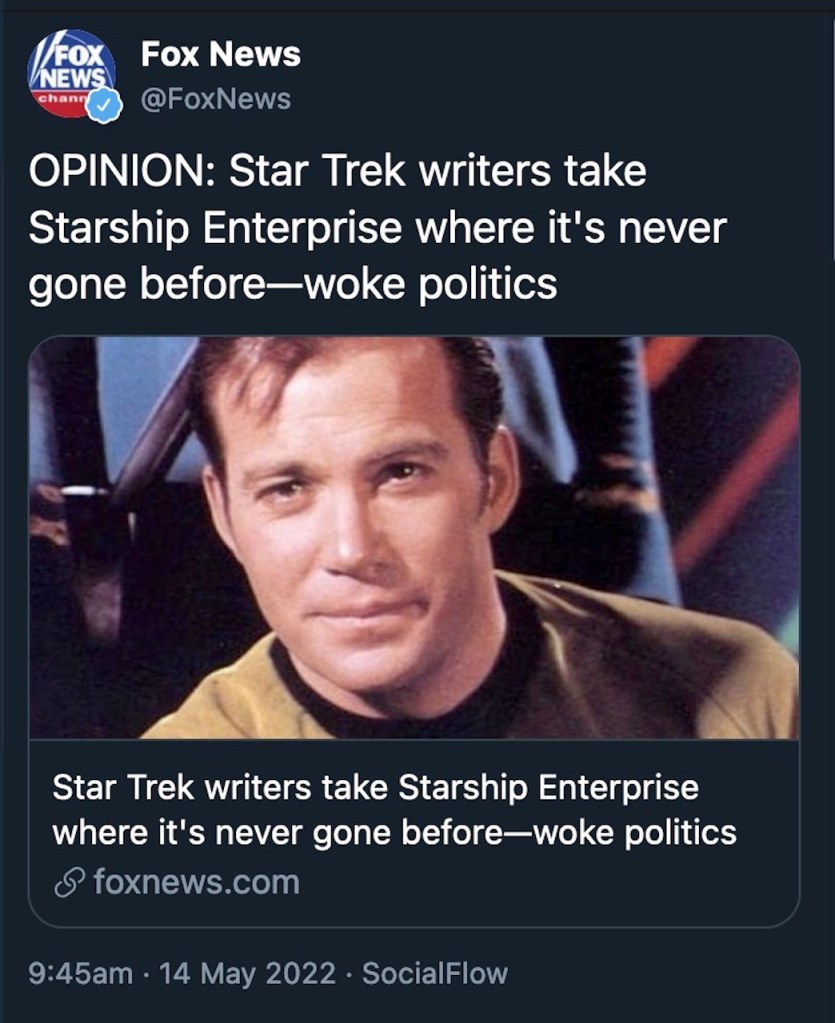
My immediate reaction was: tell me you’ve never watched Star Trek, without telling me you’ve never watched Star Trek—a show that has been woke as fuck for decades, long before the Right decided to co-opt the term in its crazed culture war, and ongoing battle to take this country back to the “good old days.”
You know, the good old days, when women “belonged” to their fathers and husbands, Black and brown folk belonged to White folk, and LGBTQ+ folk hid in their closets.
The Right’s current trajectory as a Christo-fascist kakistocracy is peopled with pundits and leaders who—as pundits and leaders in authoritarian leaning movements are wont to do—not only lie about current news and events, but gaslight and rewrite literal and cultural history as well. In their dystopian hellscape, every hint of liberal or progressive idealism is a direct attack on them, every instance of inclusivity or diversity is just more proof in support of their racist replacement theory, and according to them, every hint of it, is nothing but political posturing, and dismissed as “woke.”
And so, we get the above, untethered-from-reality, and disingenuously manipulative, opinion piece published by Fox News, the author of which purports to be a fan, but seems to believe that only certain topics (like saving whales), or certain ways of discussing issues (apolitically), are acceptable in a show like Star Trek, and anything else is “electioneering” or campaigning for one political party over the other, and apparently, that digging deep into uncomfortable socio-political topics is a brand new bridge too far for Star Trek.1 The ridiculousness of this perspective is belied by the history of this storied entertainment franchise.
Star Trek first aired in September 1966, and ended its run in June 1969. The show was utterly groundbreaking and thoroughly “woke” from the get go. In fact, NBC worried that the original pilot was too cerebral and ordered a new pilot, and later, that the show’s demographic skewed too far to young and educated viewers. The original pilot would later be aired as the episode “The Cage”.
At the show’s start, it had been a mere nineteen months since Bloody Sunday—when a then just 25 year old John Lewis was nearly killed as he, and other marchers, attempted to cross the Edmund Pettus Bridge in Selma, Alabama—a short two years since the Civil Rights Act of 1964 had passed, and only thirteen months since the Voting Rights Act had passed. To say that America was still in the throes of a long overdue reckoning with its history of slavery, segregation, and racism, and the attendant political fallout and impact of it, is an understatement.
I point this context out so that people can truly grasp how utterly radical it was that the U.S.S. Enterprise‘s bridge officers—the officers!—included a Black woman and an Asian man2 Whoopi Goldberg has related that when she watched Star Trek as a little girl, she called out to her mother to come see “‘there’s a black lady on television and she ain’t no maid!’ I knew right then and there I could be anything I wanted to be.”3
Star Trek’s “Plato’s Stepchildren”, in which Uhura (Nichelle Nichols) and Kirk (William Shatner) share a brief kiss, aired in 1968. Although many consider it the first interracial kiss on U.S. television, it actually wasn’t. The impact of that moment, however, is clear given that long held belief, as well as the accounts of viewers and the actors over the years. Admittedly though, since the characters were forced to kiss (aliens made them do it!), some of that “wow” loses its shine.
What is relevant and important about that episode, however, is that NBC understood the mood and divided politics of the country. When the show aired, the ink was barely dry on the 1967 Supreme Court decision in Loving v. Virginia—which ruled that laws banning interracial marriage were unconstitutional—and the network was afraid enough of the anger of its southern viewers, that they attempted to film a second, kiss free version to show in those states, but Shatner and Nichols intentionally marred each take so that only the original could be used.4
Again, in light of this context on the state of racial issues in America—which were eleventy billion percent political at the time, and still are—I cannot emphasize enough just how very woke 1960’s Star Trek already was, and how it continued to be so throughout all its various series and reboots, albeit with varying degrees of success. Gene Rodenberry, the show’s creator, noted in an interview, “I have no belief that STAR TREK depicts the actual future, it depicts us, now, things we need to understand about that.”5
To that end, in January 1969’s, “Let That Be Your Last Battlefield”, the Enterprise encounters a planet at war, with each side considering the other subhuman. All the planet’s inhabitants are half black and half white, but one faction is black on the right side, white on the left, while the other is the reverse. It is that irrelevant detail, a fluke, a genetic quirk, that is the basis of their war, and it culminates in the extinction of life on their planet, save two men, one from each faction, who had been aboard the Enterprise. Yet upon discovering this utter destruction, the two continue fighting, eventually beaming down to the now lifeless planet, presumably, to kill each other. It was overt and over the top, ham handed at times, and blunt as fuck in the analogy it was making, but as Shatner said of the episode, “And so the idea of racism, the stupidity of racism, was dramatized.”6
In what is considered one of the best episodes of a Star Trek series, Deep Space 9’s, “Far Beyond The Stars”, Captain Sisko (Avery Brooks)—already a seminal figure in the Star Trek universe as being the first Black leading man—time travels (sorta) to the 1950’s, and the episode does not hold back on the racism of the period, and stands out as one that helped pave the way for later series in the universe, like Discovery, to address issues of systemic racism, queer story lines, and non-binary characters. Likewise, Deep Space 9‘s, “Past Tense”, which aired in 1995, delivered us into 2024 San Francisco, providing the characters with a glimpse of a world that was weary and had given up. It also provided an unflinching look at how untenable the growing economic divides in this country are, via the double lens of homelessness and racism, where the overwhelming numbers of homeless are gathered up into “Sanctuary Districts” (ghettos), and where Sisko and Dr. Julian Bashir (Alexander Siddig), both men of color, end up, while Dax, despite some alien features, passes as a White woman and is embraced by wealthy San Francisco society. The story isn’t subtle, and yet still did not go far enough in its examination of bigotry in this country. One of the episode’s writers, later noted that the episode was inspired by real world events—specifically then mayor of Los Angeles, Richard Riordan’s push to move the homeless away from businesses, and into enclosed spaces—saying that people criticized the episode for not presenting “both sides,” as opposed to “just the ‘liberal’ point of view—and I’m still trying to think what that means.”7 And yet, twenty-seven years later, only two years away from when the episode is set, it is striking in its assessment of where this nation sits, and where it may still head.
So, an author who pens a piece positing that Stacey Abrams’ appearance in a cameo role as the Federation’s president is some kind of brand new “wokeness”, or a major political statement (you know, because she’s president), has clearly either never watched most of the franchise—other than Star Trek IV, a.k.a. The One With The Whales—or, is disingenuously rewriting the cultural and political impact of racism, bigotry, and politics both in our history, and in that of the Star Trek franchise, to suit their agenda.8
The author’s throwaway aside that well of course the show has, and should, tackle some issues like…saving the whales, is actually a demand that this perennially political show, with its intentional social commentary, only comment on topics that don’t make the Right uncomfortable by pointing fingers directly at them. Which means, I suppose, that racism, homophobia, sexism, and insurrection would be off the table. This is much like the insistence that Colin Kapernick’s peaceful act of taking a knee in protest was an inappropriate political act for a sporting event, when it was really about the Right not wanting to be made uncomfortable when confronted with the nation’s ills.9
In addition to the racial tensions of the 1960’s, the Enterprise landed on American television screens as the Vietnam War, and the Cold War, were ramping up, and boy, if today’s Republicans think having Stacey Abrams in a cameo role as the Federation’s president is some sudden, out-of-left-field political stunt, or that depicting a dystopian future where the January 6th Insurrection was part of a series of events that led to WWIII, is some new political wokeness, well, Star Trek’s anti-authoritarian, anti-war, ethical debates about war, peace, the use of force, and everything in between, is sure to leave them with a migraine.
Primarily using the the Federation and the Klingons as stand-ins for “the west” or “free world” (America) and “the east” or “authoritarianism” (Russia), the original series never missed a chance to (mostly) criticize policy making at the end of a gun, as well as condemning totalitarianism, be it secular or religious, but also demanding that people take action against authoritarians. In 1967’s “Errand of Mercy”, the Klingons are depicted as Stalinish brutes, ruthlessly employing torture and execution when subjugating a peaceful planet inhabited by pacifists, while Kirk and Spock (Leonard Nimoy) are perplexed and frustrated by the inhabitants’ unwillingness to fight back. 1968’s “A Private Little War”, is a blatant episode about the war in Vietnam, which tackles the issue of intervening in foreign wars, and ends with the inevitability of a superpower’s intervention. Airing within days of the start of the Tet Offensive, its synergy with the resultant shift of public opinion on the war cannot be dismissed. 1967’s “A Taste of Armageddon”, doesn’t involve the Klingon’s or Federation, or particularly address America’s proxy war with Russia. The episode involves a planet where war is waged virtually, via computers, and people who reside in locations where hits have landed, are considered casualties that must report to a disintegration chamber, a horrifically cleansed version of war, where people, sheep-like, willingly go to their deaths, while the infrastructure of society remains standing. It is, unequivocally, a giant, woke commentary on the horrors of war, that aired during the escalation of the war in Vietnam. Finally, “The Doomsday Machine”, which also aired in 1967, tackled a planet killing device which Kirk compares to a nuclear bomb, and then discusses the idea of mutually assured destruction, noting, that the device was likely built without an expectation of being used…but that someone decided to use it.
Star Trek also never shied away from issues of economics and labor. For starters, in the economy of the Federation, as Captain Picard (Patrick Stewart) explains in the movie Star Trek: First Contact, money no longer exists, and “the acquisition of wealth is no longer the driving force in our lives. We work to better ourselves and the rest of humanity”, and while other races are voraciously capitalistic (hello Ferengi), the Federation seems to rely on a barter system. The little we get of their political and economic structure, suggests, well, a type of socialism.
Episodes like 1969’s “The Cloud Minders”—where the wealthy literally live above the clouds, while impoverished miners, the Torglytes, toil in zenite mines on the planet’s surface, where the mining process releases a gas which negatively affects mental capacity and emotions—address the privileges of wealth, social inequality, and the abuse of workers. Voyager continued this theme in 2001, with the two-part “Workforce”, in which members of the ship’s crew were kidnapped, and their memories erased, so they would become happy, complacent workers in an energy plant on an alien planet suffering a labor shortage. The slave labor/worker’s rights social commentary should be obvious to anyone.
I have to admit that I haven’t yet had a chance to watch Strange New Worlds. In the Fox piece, the writer claims that the show blames the events of January 6th for WWIII, with the basic message that “Orange man bad.” Since I haven’t watched it, I’m relying on summaries, reviews, and a transcript of the episode, but as descriptions of the scene note, it was actually slew of images from many events shown, which yes, began with the January 6th Insurrection, but which also depicted BLM protests, a “left wing riot,” and, ultimate ends with Pike stating that these various conflicts culminated in Second Civil War, then the Eugenics Wars, then finally World War III—the latter two of which are already part of established, canonical Star Trek lore.10 Then, Pike says, “You’re going to use competing ideas of freedom to bomb each other to rubble, just like we did, and then your last day will be just like that.” If anything, the scene smacks of both side-ism, which is apparent in Pike’s exhortations for the parties to negotiate peace, despite acknowledging the impossibility of doing so when one side refuses to negotiate, and his despite eventually conceding to the axiom that “he who has the biggest stick wins.”.11 The Fox article’s failure to discuss the entire scene, including how it finger points to all sides, is manipulative, a lie of omission, and calculated to inflame Fox devotees and Republicans, who already downplay and deny the events of January 6th, framing it as “legitimate political discourse”, “a mob of misfits,” “a normal tourist visit,” and ignoring the deaths of capitol police.12
I’d be remiss if I didn’t also discuss how, until very recently, and despite the intentions of many, the Star Trek franchise has only handled sexism and LGBTQ+ issues in, shall we say, a mediocre way? But, the show runners did attempt to inject those themes into story lines and casting decisions. In 1995, Voyager launched with Captain Janeway (Kate Mulgrew), our first female captain, at the helm, during a time when women in the U.S. military were still barred from active combat units, and thus opportunities for meaningful promotion. Star Trek: The Next Generation, cast Gates McFadden as Dr. Beverly Crusher, the franchise’s first female ship’s doctor. Next Generation also attempted to tackle LGBTQ+ issues, and conversion therapy, with rather mixed results.
In 1991’s “The Host”, Beverly becomes involved with a Trill ambassador. The Trill are a symbiotic species, residing within a humanoid host. When the ambassador’s host dies, and ends up in a female body, Beverly declines to pursue the relationship, noting that her inability to handle the gender transition (and thus a bisexual or gay relationship) is a “human” problem, when really it’s a Beverly problem. The criticism of this cop-out is legitimate, and yet, today, as in 1991, bisexuals are still struggling for acceptance, even within the LGBTQ+ community. So, perhaps Beverly was right that it’s a bigger issue than one person’s apparent homophobia.13
The Next Generation‘s “The Outcast”, which aired in 1992, took place on a planet where the people professed to be a completely androgynous race. The J’naii, eschewed sexual relations as a perversion, believing they’d evolved past such primitive behavior. During the course of the episode, Commander Riker (Jonathon Frakes), and a J’naii named Soren, become attracted to each other, and Soren eventually admits to identifying as female. When they are discovered, Soren is arrested, tried, and sentenced to their version of conversion therapy. Riker returns to the planet to save her, only to discover he’s too late, and Soren has been “reeducated”, and no longer has feelings for him. While the episode engendered legitimate criticism from the LGBTQ+ community, it is of particular relevance today, when the Right is attacking gay and transgender citizens across the nation, and many still support conversion therapy as a means of “curing” gay people. Deep Space Nine toyed with the issue, somewhat, in the form of Jadzia Dax (Terry Ferrell), a Trill officer aboard the space station, who had a few different relationships during her tenure, with both male and female identifying characters, but in reality it was LGBTQ+ representation by proxy.14
These inconsistencies and issues, however, are finally being addressed in both, Picard and Discovery, two of the newest shows in the franchise (along with Strange New Worlds, Lower Decks, and Prodigy, with more on the horizon). Two of Picard’s most kick-ass females, Seven (Jeri Ryan) and Rafi (Michelle Hurd) are in relationship (gasp it’s both interracial and gay!). It’s also of note, that Picard’s first season, which was developed, written, and aired during the Trump administration, addressed a refugee crisis, as well as the dangers of authoritarianism, including parallels to our own withdrawal from the world’s stage as a standard bearer of democratic value.
The galaxy was mourning, burying its dead, and Starfleet slunk from its duties. The decision to call off the rescue and to abandon those people we had sworn to save was not just dishonorable, it was downright criminal! And I was not prepared to stand by and be a spectator!
Jean Luc Picard, “Remembrance”
Discovery boasts one of the most diverse casts in the history of the franchise, particularly with regard to female characters, and characters of color. Malaysian actress Michelle Yeoh, was cast as Captain Philippa Georgiou, and Sonequa Martin-Green’s as Michael Burnham, Georgiou’s first officer, the eventual captain of Discovery, and the franchise’s first Black, female captain and show lead. Discovery‘s primary crew is peopled by several women and people of color, and includes a canonically gay couple—whose story is not centered on their homosexuality, and who are played by openly gay actors (Anthony Rapp and Wilson Cruz)—and all the characters are integral members of the crew, not merely token ones, even when they are in a supporting role. In a groundbreaking move, the crew also includes a pair LGBTQ+ young adults, who are in a relationship as well: Adira (Blu del Barrio), a non-binary human cadet, who is host for a Trill, and Gray Tal (Ian Alexander) a transgender male, and the previous host of the Trill that Adira now hosts, both of whom are played by non-binary and transgender actors, respectively.
These choices have led to much complaining from the perennially unhappy “toxic male” part of fandom, as well as pundits like the one that penned this revisionist tripe.15 According to the author of the article, there’s a “difference between showing broad support for things like basic civil rights and openly advocating for one political party’s answers for securing them.” This would be a legitimate argument, if we weren’t at the point where one party, and only one party, is actively attacking people’s civil rights, while the other is trying, however ineffectively, to stop them. Of course, perhaps what he really means is that the Black community, or the LGBTQ+ community, are not entitled to those “basic civil rights” in the first place, or that maybe they’re only entitled to the most “basic” ones, but not other ones?
It seems to me that—being allowed to express one’s true self safely (Florida’s “Don’t Say Gay” law), exercising the right to vote (voter suppression laws across dozens of states), serve in the military (Trump era reversal of transgender citizens serving), teach in schools (Oklahoma teacher fired for “grooming” after telling his LGBTQ students he supported them), raise families (Texas investigating families with transgender children, Tennessee legalizing discrimination by faith-based adoption agencies), and many more matters that Right wing legislative bills are addressing—are all in fact “basic civil rights,” and that regardless of how Fox would like to revise history and gaslight us, Star Trek has always been about more than just “basic civil rights.” It has been about progress and the expansion of humanity, in all its forms.
Change is the essential process of all existence.
Spock, “Let This Be Your Battlefield”
A concept terrifying to the very foundation of conservatism.
The author doubles down on this idea that Star Trek is being needlessly political, stating “almost everyone supports ‘voting rights’ but that isn’t the same as supporting Stacey Abrams. Almost everyone condemns the Capitol riot and political violence, but that’s not the same and placing unique blame on one single event from one side of the spectrum.”
To which my husband said, “But do they really?”
Because no, they actually don’t.
When only one party is passing ever more restrictive voting laws, with the intended purpose of suppressing the vote of democrats generally, and minorities specifically, it is patently obvious the author’s premise is faulty. Further, the audacity of the author to claim that almost everyone condemns the Insurrection, and political violence, is quite something else, as the claim is absurd and patently false. His very use of the phrase “riot” instead of insurrection, is a perfect example of the Right’s attempt to deflect and minimize the events of January 6, 2021. When polling indicates that 40% of Republicans, and 41% of Independents believe violent action against the government is justified, and 52% of Republicans believe the January 6th insurrectionists were protecting democracy, the claim that most people condemn the insurrection and political violence becomes absurd, because while yes, generally most people do, a very large swath of Republicans and conservative independents—the people the article was written for—do not, and for someone making the argument that a show is unfairly pitting two parties against each other, that attempt to elide the difference is manipulative.16
The last several years have demonstrated that allowing media, regardless of which, to engage in “both sides-ism”, and conservative media in particular to engage in targeted, revisionist history, and attacks on entertainment that they perceive as critical of the Right, has helped further divide this nation along partisan lines. This revisionism is nothing less than propaganda in a culture war being waged by people so desperate to hold on to power, they’re targeting and inflaming the fears of millions of Americans, and weaponizing it against democracy. Articles like this, which elide and manipulate facts, must be called out and challenged if we hope to have honest conversations, rooted in fact, not propaganda.
Everyone is entitled to his own opinion, but not to his own facts.
Daniel Patrick Moynihan
Footnotes
1. I am not providing a link to the article, as I have no desire to increase their “clicks,” but if you want to read it, it should be easy to find. As Orwell additionally noted, “In our age there is no such thing as ‘keeping out of politics.’ All issues are political issues…” George Orwell, All Art is Propaganda: Critical Essays. To pretend that a discussion of social issues, particularly major ones, can be apolitical is ridiculous.
2. It should be noted that George Takei, who played Lt. Sulu, is a Japanese American who, as a child, was sent to internment camps with his family during WWII.
3. https://www.startrek.com/database_article/goldberg-whoopi
4. https://timeline.com/star-trek-interracial-kiss-ba0948687788
5. https://www.ibiblio.org/jwsnyder/wisdom/trek.html
8. According to the Fox News article, her cameo was “electioneering,” despite the fact that it was filmed in the summer of 2021, six months before she announced her candidacy for governor. https://www.yahoo.com/entertainment/star-trek-discovery-stacey-abrams-michelle-paradise-210307311.html
9. When protestors loudly took to the streets instead, they were told that this too was inappropriate. In sum, the Right did not want to hear about it, period.
11. https://transcripts.foreverdreaming.org/viewtopic.php?f=1381&t=72376
12. https://www.nytimes.com/2022/02/04/us/politics/republicans-jan-6-cheney-censure.html;https://www.marketwatch.com/story/democrats-decry-revisionist-history-as-republicans-downplay-capitol-riot-at-hearing-01620858977
13. Take a few minutes to research biphobia, and how it negatively impacts the health and well being of bisexuals.
14. “[I]n the absence of any explicitly queer characters, many LGBTQ “Trek” fans saw the Trill as the next best thing.” https://variety.com/2020/tv/news/star-trek-discovery-trans-non-binary-blu-del-barrio-ian-alexander-1234824183/
15. Before the “not all men” cries begin, let me be clear: I’m not saying that all men in fandom are toxic. I’m saying there is a “toxic male” portion of fandom. That is who I’m referencing. Their sexism, homophobia, transphobia, or racism is rarely stataed in blatant terms, instead they complain about too much “wokeness”, allege that the diversity of the cast is merely stunt, or that the acting, or writing, or story lines aren’t good, and while people of differing sensibilities may disagree on such media, there is a pervasive White maleness, and little objective support, in most of what I’ve read and seen online.
16. https://www.washingtonpost.com/opinions/2022/01/03/republicans-under-authoritarian-grip/
 Musings of a Restless Mind